By Company
Googliness Interview Questions: 10 Real Examples and How to Answer Them
The quick answer: Googliness means Google’s scored behavioral rubric — not a personality quiz or ‘culture fit’ vibe. Also spelled ‘Googleyness’, it is one of the four dimensions every Google interviewer rates 1–4: intellectual humility, comfort with ambiguity, bias to action, collaborative spirit, and constructively challenging the status quo. It is tested directly in the ‘Googliness round’ and embedded in every other round of the loop.
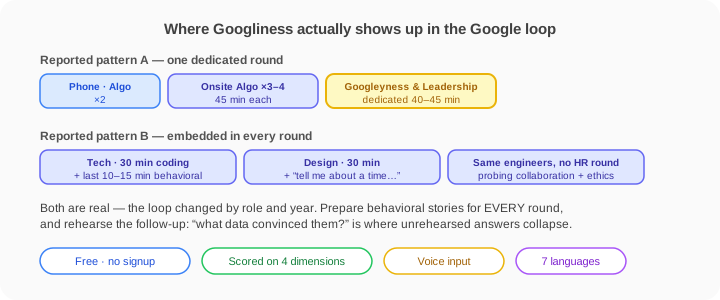
When candidates ask ‘what is googliness?’, they usually expect a fun-house answer about bean bags and quirky hobbies. The real answer is narrower and more useful: Googliness is a defined, rubric-scored behavioral dimension. It predicts how you operate when the data is incomplete, your team disagrees with you, and nobody has told you what to do. These ten questions come from real Google interview loops — each one targets a specific Googliness attribute, and each has a complete STAR answer you can reverse-engineer into your own stories.
Why Interviewers Ask These Questions
- 1Google wants evidence you thrive without a script — ambiguity tolerance is scored, not guessed.
- 2Googliness is rated in every round by every interviewer, on the same rubric as technical skill.
- 3The hiring committee never met you — your answers have to demonstrate the behaviors in concrete detail.
- 4Google moved away from vague ‘culture fit’ language; Googliness attributes are deliberately observable.
- 5A weak Googliness score can sink an otherwise strong packet, so interviewers probe hard for it.
10 Interview Questions with STAR Answers
Tell me about a time you had to influence without authority.
I identified a critical security vulnerability but the responsible team had other priorities.
I needed to get the fix prioritized without escalating to management.
I documented the risk with specific scenarios and potential impact. I scheduled a 1:1 with the tech lead, presented the data, and offered to help with the fix myself.
The team prioritized the fix within a week. My documentation became the template for future security reviews across the organization.
💡 Tips for this answer
- •Show you can lead without formal authority.
- •Demonstrate data-driven persuasion.
- •Highlight collaborative problem-solving.
Describe a time you dealt with a difficult teammate.
A teammate consistently missed deadlines, blocking our team’s progress.
I needed to address the issue without damaging the relationship.
I had a private conversation to understand their challenges. I learned they were overwhelmed with multiple projects. I helped them prioritize and offered to take on some tasks.
Their delivery improved by 80%. We built a strong working relationship, and they later mentored new team members on time management.
💡 Tips for this answer
- •Show empathy and understanding.
- •Focus on solutions, not blame.
- •Demonstrate you invested in the relationship.
Give an example of when you had to learn something quickly.
I was assigned to a project using a technology I had never worked with before.
I needed to become productive within 2 weeks.
I took an online course, studied the codebase, paired with experienced engineers, and built a small prototype to test my understanding.
I delivered my first feature on time. Within a month, I was reviewing code in that technology and mentoring another new team member.
💡 Tips for this answer
- •Show your learning process, not just the outcome.
- •Demonstrate you’re resourceful and proactive.
- •Highlight how you contributed while learning.
Tell me about a mistake you made at work. What did you learn?
Early in my career I shipped a database migration that dropped a column other services still read, causing 20 minutes of failed checkouts.
I had to restore service and rebuild trust with teams that relied on the schema.
I rolled back the migration immediately, then wrote a blameless incident report. I learned the root cause: I had skipped the cross-team schema review process because the change looked trivial. I proposed and built a CI check that flags column removals with live readers.
The rollback took 12 minutes and no data was lost. The CI check was adopted org-wide and caught three similar mistakes before they shipped. Interviewers here are testing intellectual humility — own the mistake plainly, don’t blame the process or a teammate.
💡 Tips for this answer
- •Pick a real mistake with real cost — not a humble-brag.
- •Spend half the answer on what you changed permanently afterward.
- •Never say ‘we’ when you mean ‘I’ — ownership is the signal.
Describe a time you changed your mind based on data or feedback.
I advocated for a push-based WebSocket architecture for our notification system; a colleague argued for server-sent events. We debated for a week without resolution.
I needed to resolve the disagreement on evidence instead of persistence.
I proposed we each prototype the same three use cases, then benchmark latency, throughput, cost, and complexity side by side. A day of work each replaced a week of arguing.
The data showed SSE was cheaper and simpler for our actual traffic pattern. I changed my position, we shipped SSE, and it handled 10x projected load during month one. My colleague said it was the healthiest technical disagreement they’d had — resolved with data, not politics.
💡 Tips for this answer
- •This is the canonical intellectual-humility question — have it ready.
- •State clearly what you believed before, and what specifically changed your mind.
- •End with the outcome of being wrong, not the discomfort of it.
Tell me about a time you had to make a decision without enough information.
I was asked to lead an initiative to ‘improve developer productivity’ — a vague directive with no scope, metrics, or timeline.
I had to define the problem itself before solving it, without waiting for someone to hand me a specification.
I ran 20 interviews across 5 teams and quantified the top pain points: 45-minute CI pipelines, 3-day review turnaround, 2-day environment setup. I proposed three workstreams with hard targets and got alignment before writing code.
CI dropped to 12 minutes, reviews to 16 hours, setup to 45 minutes. Developer satisfaction rose from 3.1 to 4.4. The measurement framework became the company-wide standard.
💡 Tips for this answer
- •Comfort with ambiguity = creating structure, not enduring it. Show the mechanism you used to create it.
- •Narrate how you decided what to measure when nobody told you.
- •A vague directive followed by concrete numbers is the ideal arc.
Describe a time you received critical feedback. How did you respond?
My manager told me my design docs were technically solid but unreadable — reviewers skipped them and decisions got made in side conversations instead.
I had to change a communication habit I didn’t know I had.
I asked two reviewers to think aloud while reading a doc — they got lost in page three both times. I restructured every doc to lead with the decision, one page of context, then appendices. I asked my manager for a check-in on the next three docs.
Review comments went from 2 per doc to 15+. Two of my doc templates became team conventions. The feedback stung at first; the fix compounded into how I work.
💡 Tips for this answer
- •Google reads this as intellectual humility in real time — don’t dress the feedback up as a compliment.
- •Name the emotional reaction briefly, then focus on the behavioral change.
- •Close with external evidence the change stuck.
Tell me about a time you disagreed with your manager. What did you do?
My manager wanted to delay our testing-framework migration until end of quarter; I believed the 40-minute test suite and 12% flake rate were actively causing missed releases.
I needed to challenge up without turning it into a standoff.
I built a two-week proof-of-concept on one service, documented before/after numbers, and presented the migration cost honestly — including why my manager’s timing concern was legitimate. I proposed a phased plan that protected the quarter’s deliverables.
My manager approved the phased migration. Eight weeks later test time dropped 85% and coverage rose because engineers stopped skipping tests. Disagreeing with data, then committing to the decision either way, is exactly what this question probes.
💡 Tips for this answer
- •Show you engaged the manager’s actual concern, not a strawman of it.
- •"Disagree and commit" — say what you did if you had lost the argument.
- •Bring numbers; ‘I felt strongly’ scores nothing here.
How do you handle it when everything is urgent at the same time?
In one sprint my team held a production incident response, a contractual deadline, and a security patch — all marked P0 by different stakeholders.
I needed a defensible way to sequence work when everything had a louder advocate.
I scored all three on customer impact, reversibility, and hard deadlines. The security patch had an external compliance date; the contract deadline had 4 days of buffer; the incident work was already in flight. I published the ranking and rationale — visible to all stakeholders — and negotiated scope down on the contractual item.
All three landed: patch on compliance day, contract delivered a week later with reduced scope, incident closed same week. The impact/reversibility scoring sheet became how the team triaged thereafter.
💡 Tips for this answer
- •There is no correct ranking — they are grading the decision framework you can articulate.
- •Say who you informed and how, not just what you chose.
- •Mention one thing you deliberately deprioritized. Prioritizing without sacrificing is a red flag.
Tell me about something you’re passionate about outside work. Why?
For three years I’ve run a weekly community workshop teaching basic electronics to middle-schoolers in my district.
I wanted the program to survive without depending entirely on me.
I wrote a repeatable curriculum, recruited two volunteer co-teachers, and partnered with the school’s science department for space and equipment.
The workshop now runs 12 sessions a year with 30 students per cycle, and it continues when I travel. Students’ science-course enrollment rose measurably in the participating classrooms.
💡 Tips for this answer
- •This probes intrinsic motivation and bias to action — pick something you actually did, not something you enjoy consuming.
- •Depth beats breadth: years of one thing > a list of hobbies.
- •Show agency: what did you make, teach, fix, or build?
Common Mistakes to Avoid
- ✕Treating ‘googliness’ as a personality quiz — it’s a scored behavioral rubric.
- ✕Being too polished; Google explicitly values authenticity and intellectual humility over rehearsed charm.
- ✕Stories with no numbers — vague results don’t survive second-level probing.
- ✕Answering the Googliness question with a purely technical story — skills and behaviors are scored separately.
- ✕Skipping the follow-up layer: every story needs enough detail to survive ‘what specifically did you do?’ twice.
- ✕Confusing Googliness with ‘culture fit’ — the attributes are defined and observable on purpose.
Frequently Asked Questions
What is Googliness in a Google interview?↓
Googliness is one of the four dimensions every Google interviewer rates every candidate on, alongside General Cognitive Ability, Leadership, and Role-Related Knowledge. It covers specific observable behaviors: intellectual humility, bias to action, comfort with ambiguity, collaborative nature, valuing diverse perspectives, and constructively challenging the status quo. It is not ‘fun to grab a beer with’ culture fit — the term was deliberately defined as measurable behaviors.
Is it spelled Googliness or Googleyness?↓
Both spellings appear in Google materials and interview prep communities — ‘Googleyness’ is the older internal spelling, ‘Googliness’ is the more common one externally. They refer to the same evaluation dimension, and candidates searching either term get identical results.
Is there still a dedicated Googliness round?↓
The dedicated behavioral round — sometimes called Googliness and Leadership or General Cognitive Ability — still exists in most loops, but Googliness is scored in every round. A coding interviewer who observes how you handle an ambiguous problem statement is scoring Googliness whether you meant to display it or not.
How is Googliness different from behavioral interviews at other companies?↓
Most companies ask behavioral questions about demonstrated competencies. Google scores every answer against defined attribute rubrics — humility, ambiguity, collaboration, agency — and your scores go to a hiring committee that never met you. Answers need concrete, verifiable detail (names of decisions, numbers, follow-up layers) because the packet has to stand alone.
How many STAR stories do I need for the Googliness round?↓
Prepare 8–10 stories, mapped deliberately to cover each attribute: at least one where you were wrong and course-corrected (intellectual humility), one with an unclear mandate you defined yourself (ambiguity), one where you helped someone else win (collaboration), and one where you pushed back with data (challenging the status quo). Each story should land in 2–3 minutes.
Can I practice Googliness questions with AI?↓
Yes — StarInterview’s free practice tool lets you answer these exact question stems out loud and scores your Situation, Task, Action, and Result separately, with no signup required. It works for non-native English speakers too and runs in 7 languages.
What is asked in the Googliness round?↓
Structured behavioral prompts from the four scored attributes: influence without authority, a time you were wrong and course-corrected (intellectual humility), a project with no clear spec (ambiguity), a time you helped a teammate win (collaboration), and a process you changed because it was broken (challenging the status quo). Each prompt is followed by second-layer probes — ‘what specifically did you do?’, ‘whose numbers were those?’ — so every story needs detail that survives two levels of questioning.
What are Googliness principles and values?↓
There is no single official list — the term has four public definitions (old internal slang, the 2015 People Ops book, Google's candidate prep pack, and the interviewer rubric) that disagree on wording. The rubric version is what gets scored: thrives in ambiguity, values feedback, challenges the status quo, puts the user first, cares about the team, does the right thing. Prepare one STAR story per behavior rather than memorizing anyone's favorite quote. See the full definition lineage on our Google interview guide.
What is the googliness and leadership interview?↓
It's the behavioral round of Google's onsite loop under its full interviewer-training name — the same round some recruiters call 'Leadership and Rapport' and some loops fold into General Cognitive Ability. Four labels, one rubric: the interviewer scores Googliness attributes (ambiguity, humility, collaboration) and Leadership behaviors (influence without authority, driving outcomes) on the same feedback form, usually 45 minutes of past-tense STAR prompts. One story can score both dimensions, so prep a shared story bank instead of two. The naming map is on our Google interview guide.
Should I use STAR or STAR-L for Googliness questions?↓
Use STAR-L — the same Situation-Task-Action-Result structure plus one closing 'Learnings' beat. The L matters more at Google than anywhere else because intellectual humility is the most heavily weighted Googliness attribute: stating what a mistake permanently changed about how you work is direct rubric evidence, not a nicety. Keep it to one or two sentences and specific ('I now benchmark before I advocate'), never a moral. Practice tools that score the four STAR dimensions separately let you verify the scored beats first — StarInterview grades S, T, A and R individually, free and without signup, in 7 languages.
What is asked in the googliness round in Google's loop, concretely?↓
Expect past-tense behavioral stems mapped to the scored rubric — a time you were wrong, a project with no spec, a teammate you unblocked, a process you challenged with data, a decision you made with incomplete facts — each followed by second-layer probes ('what specifically did you do?', 'whose numbers were those?'). Some loops fold the same behaviors into every technical round instead of running a dedicated one; the naming map (four labels, one rubric) is on our Google interview guide.
How do I prepare for the googliness round without memorizing answers?↓
Don't memorize — story-mine. Write 8-10 STAR stories first, then check coverage: every scored behavior (ambiguity, feedback, status quo, user-first, team, integrity) should have at least one story behind it. Rehearse out loud at 2-3 minutes per story and have someone — or a free AI scorer that rates Situation, Task, Action and Result separately — verify each story survives 'what did you personally do?' twice. A story that only survives one pass is an anecdote; one that survives two probes is evidence.
What is asked in the googliness round, in Google's own words?↓
Google's candidate prep guidance compresses the round into four framing questions: how you work individually and on a team, how you help others, how you navigate ambiguity, and how you push yourself outside your comfort zone. All six scored rubric behaviors live inside those four — every question on this page is a concrete stem fired by one of them (check the attribute tag above each question against the crosswalk on our Google interview guide). Prep implication: your story bank needs one defensible story per framing question, not one per trivia behavior.
Practice these questions with AI
Get instant feedback on your STAR method answers. Free, no signup.
Start Practicing →