Sales Interview Questions and Answers — 60-Second STAR Examples (2026)
The direct answer: sales interview questions and answers are graded on three things underneath every question — whether you generate your own pipeline, whether a “no” changes your story, and whether your wins came from a repeatable process. Every model answer below fits 60 spoken seconds, includes one real number, and ends on the result; the full “sell me this pen” framework is in its own section, and the free tool scores your delivery out loud.
Why Sales Interviews Are Almost Entirely Behavioral
Anyone can recite a sales playbook in an interview room. What the loop actually tests is whether you can hold a line when a prospect says “too expensive” for the fifth time, close when the decision-maker goes dark, and pick yourself up after a no. Behavioral questions predict those moments because they already happened to you once.
That’s why every answer on this page follows STAR — Situation, Task, Action, Result — compressed to sixty spoken seconds. Written-style 200-word answers fail in the room the same way they fail on a phone screen : nobody has 200 seconds, and rambling reads as weak pipeline discipline.
The STAR method helps you turn wins, losses, and rejections into stories you can say out loud without freezing — drill them in our behavioral question guide or see the dimension-by-dimension example answers.
"Sell Me This Pen" — The 5-Step Structure Top Candidates Use
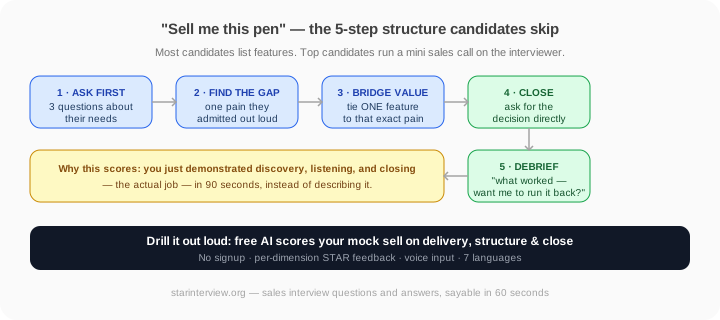
It’s the most asked live demonstration in sales interviews and the most failed, because candidates treat it as a pitch exercise. It isn’t: the interviewer is buying the process, not the pen. Run these five moves in order — the diagram above maps them.
- 1Ask before you say. Three questions about how they use pens and what annoys them. Whoever speaks first, loses.
- 2Find the admitted gap. One pain they said out loud — 'my notes fall off the page,' 'it dies mid-signature.' Quote it back in their words.
- 3Bridge exactly one feature to that pain. Not five features. One: 'you said you lose notes off the page — this tip locks them.'
- 4Ask for the decision. 'Would you buy it for twelve dollars right now?' Closing is in the script, not implied.
- 5Debrief on the spot. 'What worked there — want me to run it back?' This is the move almost nobody makes, and it shows coachability, the trait sales managers rank above charm.
Rehearsed aloud, this lands in 90 seconds. The free practice tool scores your mock sell on structure and delivery the way the interviewer’s rubric does — no signup, works in all seven languages.
The 6 Questions You’ll Actually Get — Sayable STAR Answers
These come from sales loops at companies like Salesforce, HubSpot, and Zoom — plus what hiring managers say they’re really grading underneath each one.
Tell me about a time you lost a deal you were sure you'd close.
Situation: a mid-market renewal I'd forecasted at 95 percent probability. Task: keep a two-year customer whose champion was rotating to a new team. Action: I rebuilt the business case for the incoming owner instead of pressing the old relationship — two working sessions, a usage audit, a scaled-down first year. Result: they renewed at 60 percent of the original size, and expanded eighteen months later. What I learned: a champion is not a contract.
What it’s really testing: Accountability without blame. Interviewers listen for what *you* changed afterward — a post-mortem habit beats a perfect record.
Describe a situation where you had to handle a difficult objection.
Situation: the prospect said our price was three times a competitor's after a demo they'd loved. Task: hold full price without insulting their procurement team. Action: I asked them to walk me through their evaluation criteria — turns out implementation speed was weighted highest — and costed their 3-month delay against our 2-week rollout. Result: signed at list price on a two-year term; I finished the quarter at 120 percent of quota.
What it’s really testing: Whether you reframe toward value instead of reaching for the discount button. The criteria question is the tell.
Give me an example of when you exceeded your quota.
Situation: I took over the worst-performing territory in the region at 71 percent attainment. Task: get back to plan within two quarters. Action: I cut the pipeline of deals that couldn't reach a decision-maker in 30 days and rebuilt outbound around the one vertical where we had case studies. Result: 118 percent attainment the next two quarters, and the vertical became the team's template. The number I'm proudest of is the pipeline I deleted, not the deals I added.
What it’s really testing: Process behind the win. 'I worked really hard' scores zero; a specific lever someone else could copy scores high.
Tell me about a time you had to sell to a skeptical prospect.
Situation: a VP who'd been burned by a vendor two years prior and opened the call telling me he expected the same. Task: earn one honest discovery session. Action: I asked to hear the failed implementation first, then built my pitch around the two things the last vendor promised and didn't deliver, with a reference customer he could call himself. Result: he didn't buy that quarter — he bought the next one, and asked to be the reference.
What it’s really testing: Patience and evidence-gathering. Closing a skeptic is about proof, not pressure.
How do you handle rejection?
Give them the system, not the sentiment: 'I track my no's. Early in my SDR role I was averaging fourteen dials before a conversation, and it was grinding me — so I started logging why each no happened: wrong contact, wrong season, wrong fit. Two months later I could see sixty percent were wrong-season, so I moved my sequence timing. My connect rate went from one in fourteen to one in seven.' Rejection resilience is a measurement habit, not a positive attitude.
What it’s really testing: Everyone says they're resilient. Only candidates with a no-log can prove it.
Walk me through how you'd run our sales process for the first 90 days.
Mirror their motion: 'Days one to thirty: I shadow your top two reps, read your last ten closed-won and closed-lost deals, and map where your cycle actually stalls — I won't touch a play I haven't seen fail. Days thirty to sixty: I run my own pipeline against your current stages and flag anything in the data that contradicts the playbook. Days sixty to ninety: I bring back one specific proposal — with the deal evidence behind it.'
What it’s really testing: Listening before optimizing. New reps who announce strategy changes in week one are the answer interviewers fear.
Mistakes Sales Candidates Make
- ✕No numbers in the answer — Sales is results. Every story lands on quota attainment, deal size, win rate, or cycle time — even if the number is 'renewed at 60 percent of original size.' A number-less story reads as a participant, not an owner.
- ✕Blaming the loss on the prospect, price, or product — Own it and show the habit you built after. Interviewers hear 'lost on price' as 'I never built value.' A post-mortem ritual is the strongest sentence you can say about a lost deal.
- ✕Selling instead of demonstrating — On 'sell me this pen' and mock calls, they grade your questions and your close, not your pitch. Candidates who describe selling get asked to sell.
- ✕Preaching methodology — MEDDIC named once with a result is credibility; named five times without one is a costume. Frameworks are subtitles, outcomes are the headline.
- ✕One story, verbatim, three times — Reusing a deal is fine — rotating its angle is what makes it work. Committee selling means the same account gets told differently to finance, IT, and the end user.
- ✕Being too aggressive, or too polite — Modern loops flag both. Close with an ask, then stop talking. Silence after the close is a skill they test.
How to Prepare: Five Stories, Not Twenty Answers
You don’t need twenty scripts. You need five real deals — one won, one lost, one objection survived, one rejection you measured, one you’d run differently — each told three ways.
- ✓Write each deal with its numbers first: quota attainment, deal size, cycle length. If a story has no number, it's not ready to tell.
- ✓Rehearse out loud to a 60-second timer. If it runs long, cut context — not the result.
- ✓Run the sell-me-this-pen five steps until asking questions feels natural before describing anything.
- ✓Use the free generator to draft an answer for every question in their job description, then break it with your own numbers.
- ✓Do two or three scored practice sessions before the loop. Muscle memory closes deals; notes don't.
Related Interview Guides
Marketing Manager Interview
Behavioral questions on campaigns, brand strategy, and cross-functional work.
Leadership Interview Questions
Stories about leading teams and making the calls nobody else will.
Conflict Resolution Interview
Seven STAR examples for the difficult-customer and internal-fight families.
Mock Interview Practice Online — Free
Full-loop simulation with per-dimension STAR scoring, no signup.
Sales Interview FAQ (Real Questions, Direct Answers)
How do you answer 'sell me this pen' in an interview?
Stop describing the pen and run a mini sales call on the interviewer. Step one: ask three questions about how they use pens and what annoys them. Step two: find the one pain they admitted out loud. Step three: tie exactly one feature to that pain — 'you said you lose notes off the page; this tip locks them.' Step four: ask for the decision directly. Step five: debrief — 'what worked there, want me to run it back?' Ninety seconds, and you've demonstrated discovery, listening, and closing — the actual job — instead of talking about it.
What to say in a sales interview with no experience?
Buy any product in your life is your first story: negotiate a rent reduction, talk your way out of a fee, rally friends onto a group plan. Run it as STAR with real numbers — what the price was, what you asked, what changed. Then borrow proof: 'I've booked three of my own practice calls through cold email to [X] and can walk you through the sequence.' Interviewers hire freshers on coachability signals — a no-log habit, a shadowed call you can critique — not closed-won history.
How many sales interview questions will I get — and what are they really testing?
Usually 3–5 behavioral questions in a 45–60 minute loop, plus one live demonstration (a mock sell or a first-90-days plan). Every question grades the same three things underneath: whether you generate your own pipeline, whether you survive a 'no' without changing your story, and whether your wins came from a repeatable process. Structure every answer to answer one of those three, not the surface question.
Should I mention sales methodologies like MEDDIC or Challenger?
Once, attached to a result — 'I used MEDDIC to surface the economic buyer and re-saved a stalled deal' — then drop it. The methodology is proof you're coachable; the outcome is what they're buying. Naming a framework you can't apply to a live objection in front of you is worse than naming none.
What are good weaknesses to say in a sales interview?
Name a real one that is fixable and adjacent to the role, never the core skill: 'I used to over-qualify and starve my own pipeline — I fixed it by capping discovery at two calls before a demo.' Avoid weaknesses that ARE the job (hating cold calls for an SDR role) and avoid the disguised brag. For the full formula see our biggest-weakness answer guide.
SDR vs AE — does the question set actually change?
Same families, different weight. SDR loops hammer on prospecting stamina, rejection handling, and coachability (expect a live role-play). AE loops hammer on pipeline construction, negotiation, and multi-threading (expect deal post-mortems). Prep the same five stories either way — but change which metric each story ends on: activity metrics for SDR, revenue metrics for AE.
Can I reuse the same STAR example for several sales questions?
Yes — rotate the emphasis, not the facts. A single enterprise deal can answer 'lost deal' (what the post-mortem changed), 'difficult objection' (the pricing act), and 'most successful sale' (the close). Interviewers notice verbatim repeats; they don't notice the same deal told from a different angle because that is literally what sellers do with one account across a committee.
Last updated: October 2026 · Content reviewed monthly for accuracy