The STAR Method: How to Answer Behavioral Interview Questions (With 9 Real Examples)
The STAR method is the most effective way to answer behavioral interview questions. It helps you tell clear, structured stories from your experience that interviewers love.
What Is the STAR Method?
STAR is an acronym that stands for four key components of a strong interview answer:
Situation
Set the scene. When and where did this happen?
Task
What was your responsibility or challenge?
Action
What specific steps did YOU take?
Result
What was the outcome? Use numbers when possible.
STAR Method Example — Step by Step
“Tell me about a time you had to deal with a difficult team member.”
In my previous role as a marketing intern at Acme Inc., I was part of a five-person team launching a new product campaign. One team member consistently missed deadlines and didn't communicate about delays.
I needed to ensure we hit our launch date without creating conflict within the team.
I scheduled a private one-on-one with the team member to understand what was going on. It turned out they were overwhelmed with another project. I proposed we redistribute two of their tasks and set up a shared deadline tracker so everyone could see progress transparently.
The team member got back on track, and we launched the campaign on time. Our manager noted the improved team communication, and I was asked to lead the next project.
Free STAR Method Template (Copy & Fill In)
Use this fill-in-the-blank template to draft any STAR answer in under 5 minutes:
// S — Situation (1–2 sentences: when, where, team size)
"Last year, while working as [role] at [company], our team faced [specific problem]."
// T — Task (1 sentence: YOUR responsibility)
"I was responsible for [your goal], with [deadline/constraint]."
// A — Action (3–4 sentences: what YOU did, step by step)
"First, I [action 1]. Then I [action 2]. When [obstacle] came up, I [how you handled it]."
// R — Result (1–2 sentences: outcome + numbers)
"As a result, [measurable outcome — %, $, time saved]. My manager [recognition/impact]."
Target length when spoken: 60–120 seconds. Numbers in the Result section are what make answers memorable — if you can't quantify, describe the change in process or perception.
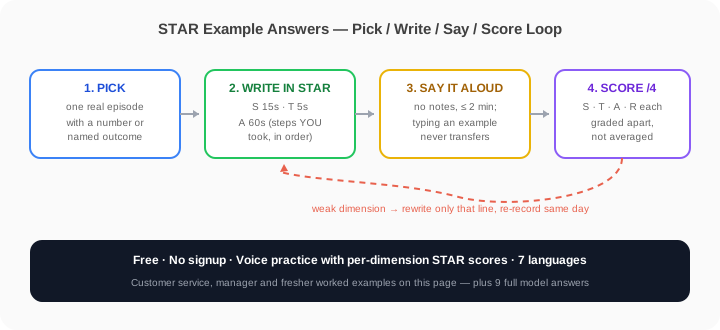
STAR Method Example Answers for Customer Service, Managers & Freshers
Search demand for STAR example answers splits three ways: customer service, management, and no-experience candidates. Same four blocks each time — with a scoring note on what makes the answer work.
Customer service
“Tell me about a time you turned around an angry customer.”SAt a telecom retailer I handled walk-in complaints; a customer arrived furious after a billing error double-charged him for two months.
TI owned the resolution on the spot — refund decision authority up to $200 sat with me, and the store was short-staffed.
AI let him finish without interrupting, repeated the two specific failures back to him, refunded within 10 minutes in front of him, then set up a plan-activation check so the same error could not recur.
RHe left with a working plan and a written apology. The follow-up check caught two more mis-billed customers that week; his retention call six months later rated the interaction 9/10.
Why this scores: Action is steps you took in order (“what YOU did”), Result carries a number and a recurrence-prevention mechanism — the two dimensions drafts lose most points on.
Managers
“Tell me about a time you managed an underperforming report.”SI led a six-person support team; one rep’s resolution rate had slid from 85% to 60% over two quarters after a tooling change.
TI needed the team’s SLA back on target without a PIP, because two other reps were watching how I handled it.
AI pulled his ticket data before the talk, found a knowledge gap on the new tool rather than effort, paired him with our top rep for three shifts, and set a weekly 15-minute check-in with explicit targets.
RHis resolution rate hit 78% by week six and 88% by the end of the quarter. The check-in format became standard for the whole team; zero unplanned attrition that year.
Why this scores: Situation names scope (team size, metric, timeframe) in one breath — the dimension manager stories most often skip straight past.
Freshers / no work experience
“Tell me about a time you worked under pressure.”SIn my final-year project our team of four lost our data-set file 5 days before the demo when a shared drive sync failed.
TAs the team’s coordinator I had to get us a usable data-set and keep the demo date, with no manager to escalate to.
AI split the recovery: two teammates rebuilt the survey form while I re-collected responses through our department network, and I cut two low-priority slides so analysis time stayed intact.
RWe demoed on time on 37 responses instead of the planned 60, and the panel graded us “strong” on methodology. I now plan every project with a backup-data step.
Why this scores: School and project episodes count the same as paid work — what interviewers grade is ownership and sequence, not the job title.
Where a STAR Answer Loses Points, Dimension by Dimension
Guides list rules; almost none show where the draft fails. This is the rubric our scoring gives line by line when you practice aloud — Situation, Task, Action and Result are graded separately, not averaged.
| Dimension | What scores | Where drafts lose it | One-line fix |
|---|---|---|---|
| Situation | When, where, scope in one or two sentences (“six-person team, two quarters”). | Backstory that runs past ~15 seconds before your first “I”. | Cut to the sentence that contains the problem. |
| Task | Your specific responsibility, not the team’s goal. | “We needed to improve X” — the interviewer never learns your role. | Start with “My job was…” in one sentence. |
| Action | Steps in order, hard parts included, “I” not “we” — roughly 60% of your airtime. | Vague verbs (“helped”, “worked on”), skipped obstacles, shared credit. | Name the one decision that changed the outcome. |
| Result | A number, a named reaction, or what permanently changed afterwards. | “It went well” — output without outcome. | If you can’t quantify, quantify the change in process or perception. |
Weak Draft → STAR Fix: Three Real Failure Patterns
The fastest way to learn the format is to see the same content told badly, then scored well. Nothing in the right column is new material — it is the same story, structured.
WEAK DRAFT
“We had a production issue and I helped fix it. It was stressful but we handled it well.”
Action + Result both score near zero: no owned steps, no outcome.
STAR FIX
“Payments were failing for 40k customers/hour. I was on-call; I traced it to an expired certificate, rolled back to a cached cert in 11 minutes, then added cert-expiry to our alert suite. No repeat since.”
WEAK DRAFT
“I dealt with a difficult coworker by communicating better.”
Action is a feeling, not a step; Task never states your role.
STAR FIX
“Two teammates disputed a £150 commission on the shop floor. I pulled the payment records, showed both had contributed equally, and proposed splitting it to our manager. The split-policy stuck.”
WEAK DRAFT
“I’m a perfectionist — I just work too hard.” (as a weakness answer)
Reads as a disguised strength; interviewers flag it and probe once.
STAR FIX
Name one real behavior, its actual cost, and the mechanism you still run to contain it. See the worked weakness answer →
STAR answers about weaknesses →9 STAR Method Examples for Common Interview Questions
Each example below is a fully answered STAR response written for a real, frequently-asked behavioral question — multiple role-tagged samples, tips, mistakes and FAQs on each linked page:
- 1."Tell me about a time you dealt with a difficult team member" — answered step by step above ↑
- 2."Tell me about a time you failed" — see full STAR answer with multiple role examples →
- 3."Tell me about a time you had a conflict" — see full STAR answer with multiple role examples →
- 4."Tell me about a time you showed leadership" — see full STAR answer with multiple role examples →
- 5."Tell me about a time you went above and beyond" — see full STAR answer with multiple role examples →
- 6."Tell me about a time you worked under pressure" — see full STAR answer with multiple role examples →
- 7."Tell me about a time you disagreed with your manager" — see full STAR answer with multiple role examples →
- 8."Tell me about a time you made a mistake" — see full STAR answer with multiple role examples →
- 9."Tell me about a time you had to learn something quickly" — see full STAR answer with multiple role examples →
Common Mistakes to Avoid
- ✕Being too vague — "I worked on a project" doesn't tell the interviewer anything.
- ✕Focusing on "we" instead of "I" — They want to know YOUR contribution.
- ✕Skipping the Result — Always close with an outcome, even if it's partial.
- ✕Rambling — Keep your total answer under 2 minutes.
- ✕Not preparing in advance — Have 5-8 STAR stories ready before your interview.
Tips for Non-Native English Speakers
- ✓Use simple, direct language. You don't need fancy vocabulary to give a great STAR answer.
- ✓Practice out loud. Writing is different from speaking — rehearse your answers verbally.
- ✓Use our AI feedback tool. It highlights unnatural phrasing and suggests clearer alternatives.
- ✓Learn key transitions. Phrases like "The situation was...", "My role was...", "I decided to...", "As a result..." make your answer flow naturally.
Practice Your STAR Answers
Ready to put the STAR method into practice? Use our free AI-powered tool to build and score your answers before your interview.
Prefer a schedule? The 7-day STAR interview prep plan turns this guide into 15-minute daily sessions with done-checks.
Start Practicing →STAR Method FAQ
What does STAR stand for in interviews?↓
STAR stands for Situation, Task, Action, and Result. It's a structured framework for answering behavioral interview questions by walking through a specific example from your experience in four clear steps.
How long should a STAR method answer be?↓
A strong STAR answer is 1-2 minutes when spoken aloud, or about 150-250 words in writing. The Situation and Task should take about 30 seconds, the Action about 45-60 seconds, and the Result about 15-30 seconds.
What types of questions should I use STAR for?↓
Use STAR for behavioral questions — those that start with 'Tell me about a time when...', 'Give me an example of...', or 'Describe a situation where...'. These questions ask about past experiences rather than hypothetical scenarios.
Can I use the same STAR example for multiple questions?↓
Yes, but adapt the emphasis. A story about leading a project can answer questions about leadership, conflict resolution, or time management — just highlight different aspects of the same experience for each question.
What if I don't have work experience for a STAR answer?↓
You can use examples from school projects, volunteer work, extracurricular activities, or personal projects. The key is showing how you handled a real situation — the context matters less than the skills you demonstrate.
What are STAR method example answers for customer service?↓
Pick a real complaint you personally de-escalated: state the failure that angered the customer, the steps you took in order (listen, repeat back, fix, prevent), and a result with a number — refund time, repeat business, retention rating. The worked customer-service example on this page shows the full pattern.
Last updated: November 2026 · Content reviewed monthly for accuracy