By Competency
Behavioral Interview Questions and Answers: 6 STAR Method Examples
The quick answer: Behavioral interview questions and answers work best in STAR format: one sentence for the Situation, one for the Task, 2-3 moves for the Action you personally took, and a Result with a number. Interviewers ask them because past behavior predicts future performance — so prepare 8-10 real stories you can say aloud in 60 seconds instead of memorizing scripts.
Behavioral interviews assess how you've handled real situations in the past. Interviewers believe past behavior predicts future performance. Using the STAR method (Situation, Task, Action, Result) helps you give structured, compelling answers.
Why Interviewers Ask These Questions
- 1Behavioral questions are used by 80%+ of companies in their interview process.
- 2They're harder to fake than hypothetical questions.
- 3They reveal your decision-making process and values.
- 4They predict job performance better than technical questions alone.
6 Interview Questions with STAR Answers
Tell me about a time you failed.
I launched a feature without adequate testing, causing a P1 incident.
I needed to fix the issue and prevent it from happening again.
I led the incident response, communicated transparently with stakeholders, and conducted a blameless post-mortem. I then built an automated testing checklist.
Zero similar incidents in the following year. The checklist was adopted by 4 other teams. I learned that speed without safety is reckless.
💡 Tips for this answer
- •Choose a real failure, not a humble brag.
- •Show genuine learning and growth.
- •Demonstrate the systemic improvement you made.
Describe a time you worked under pressure.
Our system went down during Black Friday, affecting $2M in transactions per hour.
I needed to restore service as quickly as possible.
I coordinated with 3 teams, identified the root cause in 15 minutes, implemented a hotfix, and communicated status updates every 10 minutes to stakeholders.
Service restored in 45 minutes. We recovered 95% of lost transactions. I documented the incident and built runbooks for future outages.
💡 Tips for this answer
- •Show you stay calm under pressure.
- •Demonstrate clear communication during crisis.
- •Highlight the preventive measures you implemented.
Tell me about a time you showed initiative.
I noticed our team was spending 20 hours per week on manual deployments.
No one asked me to fix it, but I saw an opportunity to improve.
I researched CI/CD tools, built a proof-of-concept, and presented the business case to my manager. I then led the implementation over 2 sprints.
Deployment time reduced from 4 hours to 15 minutes. The team saved 80 hours per month, which we redirected to feature development.
💡 Tips for this answer
- •Show you identify problems before being asked.
- •Demonstrate ownership and proactive thinking.
- •Quantify the impact of your initiative.
Tell me about a time you disagreed with a coworker.
My teammate wanted to ship a redesign I believed would break our onboarding flow for new users.
We had two weeks until launch and needed a decision both of us could defend to the rest of the team.
Instead of debating opinions, I proposed we each write down the risk we were most worried about, then ran a 5-user test on the old flow to get data. I shared the findings with my teammate one-on-one before the team meeting so it never became public disagreement.
The test showed 3 of 5 users got stuck exactly where I'd feared. We kept the visual redesign but deferred the navigation change to phase two. My teammate later told me the one-on-one step is why the disagreement never turned into friction.
💡 Tips for this answer
- •Name the tension honestly — interviewers spot invented 'perfect team' stories.
- •Show you attacked the problem, not the person.
- •End on the working relationship being intact, not just the task.
Describe a time you received tough feedback.
In my first quarterly review, my manager told me my written updates were so dense that stakeholders stopped reading them.
I needed to fix how I communicated without losing the technical detail leadership and engineering both rely on.
I asked for three specific examples of updates that failed, rewrote them in a one-line takeaway plus optional depth format, and requested a quick gut check from two readers every week for a month.
By the next quarter, stakeholders started replying to my updates with decisions instead of questions. My manager called the turnaround the fastest improvement she'd seen from me — and the takeaway-first format became the team standard.
💡 Tips for this answer
- •Pick real criticism, not a humble brag like 'I work too hard.'
- •Show the specific changed behavior, not just gratitude.
- •Prove the fix landed with an outside signal (replies, adoption).
Tell me about a time you juggled competing priorities.
Two product leads asked me for the same integration in the same sprint — one for a launch demo, one for a renewal deadline with an existing customer.
I couldn't do both at full scope and needed a split neither stakeholder felt ignored by.
I mapped what each outcome actually needed: the launch demo required a polished happy path, the renewal needed reliability on edge cases. I proposed building one integration, shipping the demo path in week one and hardening edge cases in week two, and got both stakeholders to agree on that order in a single 15-minute call I hosted.
The demo shipped on time, the renewal closed without an escalation, and the shared timeline became the template my team used for every conflicting request after that.
💡 Tips for this answer
- •Interviewers are testing how you say no — show the negotiation, not heroics.
- •Put yourself in the room that resolved it ('I hosted the call').
- •A reusable process as the Result signals seniority.
Common Mistakes to Avoid
- ✕Giving hypothetical answers instead of real examples.
- ✕Not using the STAR structure.
- ✕Choosing examples that don't demonstrate the competency being tested.
- ✕Not preparing enough stories (aim for 8-10).
Frequently Asked Questions
How many behavioral stories should I prepare?↓
Prepare 8-10 unique stories that cover different competencies: leadership, conflict, failure, initiative, teamwork, pressure, and customer focus. Each story should map to 2-3 competencies.
What if I don't have work experience?↓
Use examples from school, volunteer work, sports, or personal projects. Interviewers value the skills you demonstrate, not the context.
What are behavioral interview questions and answers?↓
Behavioral interview questions ask about past experiences: 'Tell me about a time when...' Use the STAR method to structure answers with specific Situation, Task, Action, and Result. Prepare 8-10 stories covering different competencies.
How do you answer behavioral interview questions using the STAR method?↓
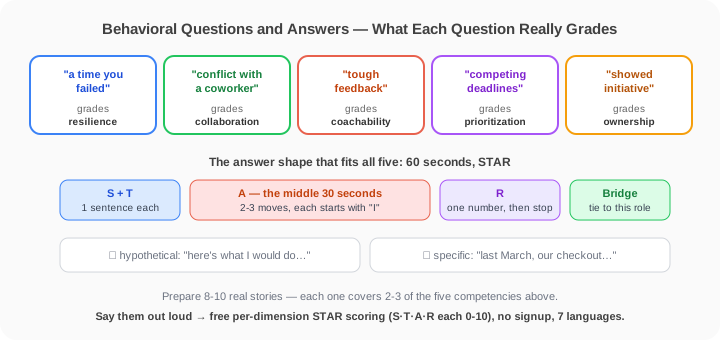
Keep Situation and Task to one sentence each, then spend the middle 30 seconds on Action — 2-3 moves you personally took, each starting with 'I'. Close with a Result that has a number or an observable change, then stop talking. Practice out loud, because a story that fits on paper often runs 90+ seconds when spoken.
How do you answer behavioral interview questions with no experience?↓
Use school projects, volunteering, sports, part-time jobs, or caring for family — interviewers score the skill demonstrated, not the setting. A conflict resolved in a student team or a deadline met during a freelance project is a valid behavioral story. Keep the same STAR shape and still end with a concrete outcome.
What are the most common behavioral interview questions?↓
Across company question banks the same five families repeat: a time you failed, a conflict with a coworker, tough feedback, competing deadlines, and a moment you showed initiative. These map to resilience, collaboration, coachability, prioritization, and ownership — the five competencies most hiring rubrics actually grade.
Practice these questions with AI
Get instant feedback on your STAR method answers. Free, no signup.
Start Practicing →