By Company
Google Behavioral Interview Questions — Googliness Round, STAR Answers & Follow-up Drills
The quick answer: Google behavioral interview questions probe four Google-specific traits — comfort with ambiguity, intellectual humility, collaboration, and impact at scale — and every answer works best in STAR: two sentences of context, 60 seconds of your own moves, one quantified result. There is no fixed question list to memorize; interviewers ask 'tell me about a time…' stems, then drill follow-ups on what YOU decided. Practicing out loud against real stems beats reading model answers.
Google behavioral interviews evaluate four areas: General Cognitive Ability, Leadership, Role-Related Knowledge, and Googleyness. Your STAR answers need to show intellectual humility, collaboration, and impact at scale.
Why Interviewers Ask These Questions
- 1Google looks for 'Googleyness' — comfort with ambiguity, bias toward action, and collaborative nature.
- 2They evaluate how you think, not just what you did.
- 3Impact at scale matters — Google wants to see your work affected many users or teams.
3 Interview Questions with STAR Answers
Tell me about a time you took a risk and it didn't work out.
I proposed migrating our authentication service to a new framework I'd researched, expecting 3x performance improvement.
I led the migration with a team of 3 engineers over 4 weeks.
After 3 weeks, we discovered the new framework had a critical incompatibility with our session management. I made the call to halt the migration and revert, documenting everything we learned.
We lost 3 weeks of work, but the documentation helped another team avoid the same mistake 6 months later. I now always build a time-boxed proof-of-concept before committing to a full migration.
💡 Tips for this answer
- •Google values intellectual humility — show you can admit mistakes.
- •Focus on what you learned, not just the failure.
- •Show the systemic improvement that came from the failure.
Describe a time you had to work with someone whose style was very different from yours.
I was paired with a designer who preferred to work asynchronously and rarely spoke in meetings, while I prefer real-time collaboration.
We needed to ship a feature together in 3 weeks.
I asked about their preferred workflow and adapted — we switched to written design docs with async comments instead of live meetings. I added structured feedback templates to make reviews more efficient.
We shipped on time and the collaboration was so effective that the async-first process was adopted by 2 other teams. I learned that adapting my style gets better results than expecting others to match mine.
💡 Tips for this answer
- •Show you adapt to others, not the other way around.
- •Demonstrate empathy and curiosity about different working styles.
- •Highlight the broader team impact of your adaptation.
Tell me about a time you had to make a decision with incomplete information.
Our team had to choose a payments vendor two weeks before launch, and the two finalists had only a week of test data each — no reliability numbers yet.
As tech lead, I owned the pick; waiting for complete data would have slipped the launch date.
I defined the two criteria that actually mattered (PCI scope and failover behavior), ran a focused 3-day load test on just those dimensions instead of a full evaluation, and documented what I was deliberately ignoring and the rollback trigger if real traffic disproved the data. I presented the decision, the uncertainty, and the kill-switch to stakeholders in one page.
We launched on time; processing hit only 0.4% failures in the first quarter, none customer-visible. The uncertainty-documentation habit was adopted by two other teams for their vendor decisions.
💡 Tips for this answer
- •Comfort with ambiguity is the #1 Googliness trait — show you decide without perfect data.
- •Name what you ignored on purpose, not just what you checked.
- •End with the guardrail you built (rollback trigger), which proves judgment, not luck.
Common Mistakes to Avoid
- ✕Not showing intellectual humility — Google hates arrogance.
- ✕Giving answers that don't demonstrate scale or impact.
- ✕Focusing too much on technical details and not enough on collaboration.
- ✕Not showing curiosity or learning from the experience.
- ✕Being too formal — Google values authentic, conversational answers.
- ✕Preparing brain-teaser 'trick answers' — recent interview reports show those questions have essentially vanished; behavioral stories are what's actually asked.
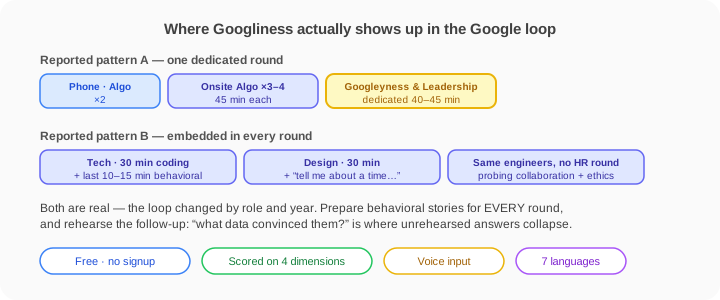
- ✕Rehearsing only the first answer — every Google behavioral answer gets follow-up probes; vague stories collapse on 'what data convinced them?'.
Frequently Asked Questions
What is Googliness in a Google interview?↓
Googliness (Google's own spelling is 'Googleyness') is the cultural-fit signal Google looks for in every round: comfort with ambiguity, intellectual humility, bias toward action, collaboration, and valuing diverse perspectives. It is not a personality test — interviewers score it through behavioral questions about things you actually did.
What is asked in the Googliness round?↓
Real candidate reports describe 'tell me about a time…' behavioral stems — conflicts, changing priorities, influence without authority, mistakes — plus hypothetical, deliberately underspecified scenarios ('how would you make a feature work for users unlike you?'). The old brain-teaser list (manhole covers, golf balls) has essentially disappeared from recent interview reports; don't prep tricks, prep stories.
Is the Googliness round a separate interview?↓
Reports differ, and both are true: some candidates get a dedicated 40–45 minute Googleyness-and-Leadership round, while others get 10–15 minutes of behavioral questions embedded at the end of technical rounds, asked by the same engineers. Plan for behavioral probes in every round, not just one.
How do interviewers follow up on Google behavioral answers?↓
Expect second-level probing: 'What alternatives did you consider?', 'What data convinced them?', 'Who did you tell?', 'What would you do differently?'. A polished first answer isn't enough — your story needs enough specific detail (numbers, decisions, people) to survive two follow-up layers. That's exactly what out-loud practice with per-dimension STAR scoring trains.
How do I practice Google behavioral and culture-fit questions?↓
Answer out loud against real Google question stems and get feedback on each STAR dimension. StarInterview's practice tool scores Situation, Task, Action, and Result separately — free, no signup required, and it works in 7 languages, which helps non-native English speakers.
Practice these questions with AI
Get instant feedback on your STAR method answers. Free, no signup.
Start Practicing →