Company Guide
Google Googliness Interview: Questions & How to Prepare
By Elara T · September 2026 · 15 min read
Googliness (also spelled Googleyness) is the behavioral dimension of Google's interview rubric — one of four traits every interviewer scores, alongside cognitive ability, leadership, and role-related knowledge. It is a defined set of observable behaviors: comfort with ambiguity, intellectual humility, bias to action, collaboration, and constructively challenging the status quo — not a personality test or "fun to work with" vibe check.
If you're preparing for a Google interview, you've probably heard the term "Googliness" (or "Googleyness") and wondered what it actually means. It's not about being quirky or fitting a stereotype. Googliness is Google's specific framework for evaluating behavioral attributes — and it's one of the four dimensions every interviewer scores you on, right alongside technical ability.
This guide explains exactly what Googliness is, how Google evaluates it, which questions to expect, and gives you complete STAR method example answers for the most common Googliness interview questions. You can also practice your Googliness answers with AI feedback for free. See also the full list of 10 real Googliness interview questions with STAR answers.
What Is Googliness?
Googliness is the term Google uses for a cluster of behavioral and cultural attributes that predict success at the company. It is not "culture fit" — Google explicitly moved away from that term because it was too vague and susceptible to bias. Instead, Googliness is defined through specific, observable behaviors:
- Intellectual Humility: You change your mind when the data says you're wrong. You don't defend positions for ego.
The typical probe: "Tell me about a time you were wrong."
- Bias to Action: You make decisions with incomplete information rather than waiting for perfect data.
The typical probe: "A decision you made without all the facts?"
- Comfort with Ambiguity: You can navigate unclear situations, define problems, and create structure where none exists.
The typical probe: "A project with no clear spec — how did you start?"
- Collaborative Nature: You help others succeed, share knowledge freely, and work effectively across teams.
The typical probe: "A time you helped a teammate succeed."
- Valuing Diverse Perspectives: You actively seek out viewpoints different from your own before making decisions.
The typical probe: "When did you change a plan because of someone else's input?"
- Challenging the Status Quo: You question existing processes constructively and drive improvements with data.
The typical probe: "A process you improved because it was broken."
Google interviewers are trained to probe for these specific behaviors using structured questions. They score your responses on a rubric — not a gut feeling. If you can demonstrate these attributes with concrete examples using the STAR method, you'll score well on Googliness.
Where "Googliness" Comes From — and Why Every Article Defines It Differently
The Googliness meaning in one sentence: it is Google's scored behavioral rubric — thrives in ambiguity, values feedback, challenges the status quo, puts the user first, cares about the team, does the right thing — rated 1–4 against anchor examples in every interview round. Anything else you read ("quirky," "fun to work with," book quotes) is older slang, not what writes your score.
Search "googliness meaning" and you will find at least four different lists of attributes, each presented as the official definition. That is not a coincidence — the concept genuinely has four public sources, and they do not fully agree. Knowing which is which tells you what actually gets scored:
- 1. The old internal slang ("Googley"). Early Googlers used it informally for "do the right thing, be curious, be good to each other" — never formally defined. Because everyone read it differently, it drifted into a bias-prone "culture fit" shortcut, and Google deliberately moved away from the vibe word toward defined behaviors. This is also why you will see the spellings Googliness, Googleyness and Googlyness used interchangeably — candidates searching any of them mean the same evaluation dimension.
- 2. The 2015 book definition. Google's former head of People Operations described Googleyness in Work Rules! as fun, intellectual humility, conscientiousness, comfort with ambiguity, and a history of courageous or interesting choices. Widely quoted online — but it is a memoir's summary, not the current interviewer rubric.
- 3. The candidate prep materials. Google's own interview prep guidance frames Googleyness as dreaming big (the "next moonshot"), thriving in ambiguity, valuing feedback, constructively challenging the status quo, and doing the right thing — and points candidates to the public company philosophy page ("Ten Things We Know to Be True") for context.
- 4. The scored rubric. Interviewer-facing summaries describe concrete behaviors: thrives in ambiguity, values feedback, challenges the status quo, puts the user first, cares about the team, does the right thing. This is the version your answers are actually matched against, because every interviewer rates you on it in every round — including the coding one.
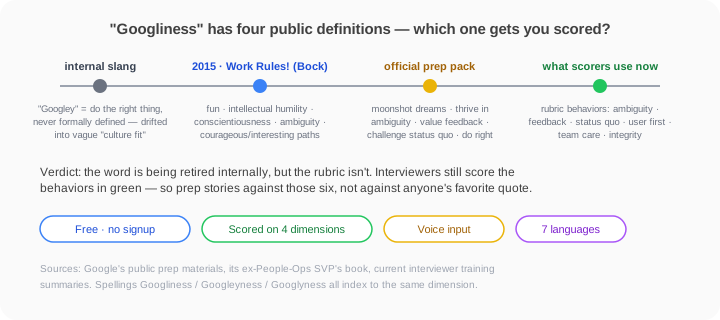
The practical takeaway: prepare stories against the rubric behaviors (version 4), not against anyone's favorite quote. If a prep article tells you Googliness means "love ping-pong and be quirky", you are reading version 1 — outdated. And once your stories exist, the gap between reading about them and saying them in 2-3 minutes under a follow-up probe is where most candidates lose the score. That gap is exactly what the free voice-practice loop closes: speak the answer, get Situation / Task / Action / Result scored separately, revise, repeat.
How Google Evaluates Googliness
Every Google interviewer rates you on four dimensions, regardless of whether the round is technical or behavioral:
1. General Cognitive Ability (GCA)
Problem-solving, learning ability, and analytical thinking. Interviewers look for how you decompose an unfamiliar problem, whether you ask clarifying questions before committing, and how quickly you incorporate a hint. GCA is scored in coding rounds too — the think-aloud process is the evidence.
2. Leadership
How you influence, mentor, and drive outcomes — even without formal authority. The scored question underneath: when the situation needed a owner, did you become one, and what changed because of it? Stories where you escalated to your manager instead of acting score weak here.
3. Role-Related Knowledge (RRK)
Technical depth and domain expertise for the specific role. For engineers this shows up in the loop's technical rounds; for PMs, analysts, and recruiters it also appears in behavioral answers — "walk me through a launch" is an RRK question wearing behavioral clothes.
4. Googleyness (Googliness)
The behavioral attributes listed above — intellectual humility, collaboration, comfort with ambiguity, bias to action, challenging the status quo. This is the dimension candidates under-prepare for, because it's never announced as a test. It's the subject of the rest of this guide.
The Googliness score is weighted equally with the other dimensions. A strong Googliness score can compensate for a weaker technical round (within reason), and a weak Googliness score can sink an otherwise strong candidate. The key insight: your packet goes to a hiring committee that never interviewed you, so your scores need to speak for themselves.
Google Googliness Interview Questions & Example STAR Answers
Below are the most common Googliness interview questions with complete STAR method answers. Each answer targets a specific Googliness attribute. Use these as templates — swap in your own experiences using the STAR answer generator.
“Tell me about a time you helped a teammate succeed.”
“Describe a situation where you had to deal with ambiguity.”
“Give an example of when you challenged the status quo.”
“How do you handle disagreements with teammates?”
Google Interview Process Overview
Understanding where Googliness fits in the overall process helps you prepare strategically:
1. Recruiter Screen
30 minA recruiter assesses basic fit, role alignment, and logistics. Light behavioral questions. Googliness is not formally scored here, but first impressions matter.
2. Phone Screen(s)
45-60 min × 1-2Technical or behavioral interviews over video. One round may include Googliness questions. Typically includes a coding problem and 10-15 minutes of behavioral questions.
3. Onsite Loop
45 min × 4-5The main event. Typically 2-3 coding/system design rounds and 1-2 behavioral rounds. The behavioral round is your primary Googliness evaluation, but every interviewer scores all four dimensions.
4. Hiring Committee
1-2 weeksA committee of experienced Google employees (not your interviewers) reviews your complete packet: all interviewer scores, your resume, and any work samples. They make the hire/no-hire decision.
5. Team Matching
1-4 weeksIf the hiring committee approves, you're matched with a team. This involves conversations with potential managers and teammates. Googliness traits matter here too — teams want someone they can collaborate with.
6. Offer
1-2 weeksCompensation is determined by level, role, and location — not by interview performance. The entire process typically takes 4-8 weeks from first contact to offer.
Googliness vs Leadership: What's the Difference?
Google evaluates both Googliness and Leadership as separate dimensions, and candidates often confuse them. Here's how they differ:
Googliness
- • How you work with others
- • Intellectual humility — changing your mind
- • Comfort navigating ambiguity
- • Valuing diverse perspectives
- • Questioning the status quo constructively
Leadership
- • How you drive outcomes
- • Influencing without authority
- • Mentoring and growing others
- • Making tough decisions under pressure
- • Taking ownership of ambiguous problems
The overlap: both require collaboration and ownership. The difference: Googliness is about who you are (character attributes), while Leadership is about what you do (driving outcomes). A strong story can demonstrate both — for example, a story where you changed your mind based on a teammate's feedback (Googliness: intellectual humility) and then led the resulting initiative to completion (Leadership: driving outcomes).
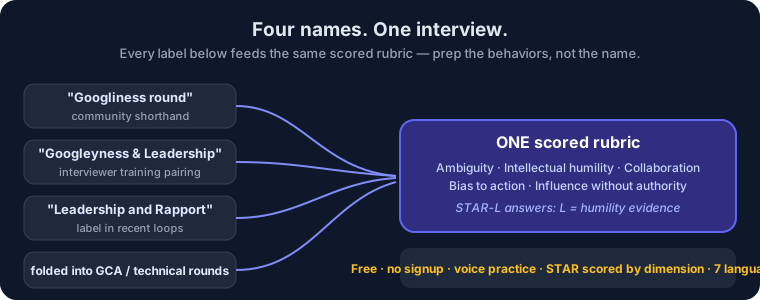
Four Names, One Round: "Googliness," "Googleyness & Leadership," "Leadership and Rapport," "GCA"
One of the most confusing things about the "googliness and leadership" interview is that it arrives under a different label in every loop — and the labels are not consistent across recruiters, prep sites, or even Google's own materials over the years:
- "Googliness round" — the community shorthand; what most candidates search for.
- "Googleyness & Leadership" — the pairing many interviewers use, because the round scores both dimensions on the same form.
- "Leadership and Rapport" — a label reported in recent loops; same behavioral prompts, same rubric.
- "General Cognitive Ability (GCA)" — in some loops there is no separate behavioral round at all; the Googliness probes are folded into the last 10-15 minutes of a technical interview.
The practical rule: ignore the round name and prep against the rubric. Whatever your invite calls it, the scored behaviors are identical — so prepare 8-10 STAR stories covering all four dimensions, and check the naming on your loop itinerary against the round map above. If every source you read uses a different name, that is not four different interviews; it is one interview with four labels.
What About Amazon's Leadership Principles?
Candidates moving between Google and Amazon loops often ask whether Googliness is just Google's version of Amazon's 16 Leadership Principles. They are related but structurally different, and mixing them up in an interview is a real (and common) mistake:
| Dimension | Google Googliness | Amazon Leadership Principles |
|---|---|---|
| Format | 6 behavioral attributes, scored 1–4 per dimension | 16 named principles (Customer Obsession, Ownership, Dive Deep…) |
| How questions work | Question stems map loosely; interviewers probe for behaviors | Questions name the principle directly — "tell me about a time you disagreed and committed" |
| Overlap | Intellectual humility ≈ "Earn Trust"; bias to action ≈ "Bias for Action"; challenging the status quo ≈ "Have Backbone; Disagree and Commit". The same STAR story can serve both loops — but frame the takeaway in the company's own vocabulary. | |
| Biggest trap | Quoting Amazon LP names inside a Google interview (or vice versa). Interviewers notice — it reads as borrowed culture instead of lived behavior. | |
If you're running Google and Amazon loops at the same time, prepare one story bank of 8–10 STAR stories and translate each one into both vocabularies. Our Amazon guide covers the leadership-principle side of the same preparation: Amazon interview questions & leadership principles.
Inside the Interviewer's Seat: How Googliness Actually Gets Scored
Understanding the mechanics behind the score changes what you should say. Here's what happens on the other side of the table:
You are scored immediately after you leave the room.
Interviewers fill out structured feedback within 24 hours — before debrief, before talking to other interviewers. There is no "we'll figure it out in the room." Your answer either contained the evidence or it didn't, and the notes are already written.
The rater sees four separate scores, not one impression.
GCA, Leadership, RRK, and Googleyness are each rated roughly 1–4 (below bar / mixed / meets / above). A great technical answer with no collaboration or humility evidence still gets a weak Googleyness line — those two scores don't leak into each other.
Evidence has to be specific enough to write down.
Interviewer notes that read "seemed collaborative" get pushed around in calibration. Notes that read "redistributed her own tasks to unblock a teammate behind a missed deadline, quantified delivery +80%" survive. Your job is to hand them sentences they're willing to write down — numbers, decisions, named tradeoffs.
The Bar Raiser exists to break exactly this tie.
Every loop has one interviewer from outside the hiring team with veto power, weighted heavily on Googleyness and leadership. Their question is not "is this person good?" but "would I hire them onto any team at Google?" — a story where you were right but arrogant, or diligent but rigid, is precisely the pattern they exist to catch.
Follow-up probes are the real signal.
Experienced interviewers score the second layer, not the first: "What would you do differently?" "What did your teammate actually say?" "Whose numbers were those?" A story that survives two probes reads as lived experience; one that collapses reads as a rehearsed anecdote — a Googleyness ding either way.
The practical consequence: answer at the level of detail a stranger could quote in a hiring committee packet. If your story can't survive being summarized in one sentence with a number in it, it can't survive the score.
Reading a Googliness score back to its anchor: four sample notes, four verdicts
- 1 — below bar: "Defended original architecture choice for 20 min; conceded only after manager overrode." ← no humility evidence; the argument itself was the data.
- 2 — mixed: "Helped junior debug race condition, but took over keyboard twice." ← collaboration intent visible; enabling behavior cancels it.
- 3 — meets bar: "Defined vague productivity mandate via 20 dev interviews; set 15-min CI target before writing code." ← textbook ambiguity thrives, specific enough to write down.
- 4 — above bar: "Changed own WebSocket position after benchmark, told team she was wrong, then co-presented the method; now benchmarks before advocating." ← humility + status-quo challenge + durable behavior change (the STAR-L beat).
Anchor rows paraphrased from the four-tier rating scale interviewer training describes — the point is the shape of note a stranger can defend in a hiring-committee debrief. Not sure whether your draft story reads as a 2 or a 4? Say it out loud and have the free scorer rate S / T / A / R separately.
The Scored Meaning vs. the Quotable Meaning of Googliness
This is the map that resolves everything above: the three popular definitions are quotable — they make good blog excerpts and bad preparation targets. The fourth is scored: it is what the interviewer's rating form actually says, and it is the only one that changes your packet. Everything in "Inside the Interviewer's Seat" above applies to the right-hand box.
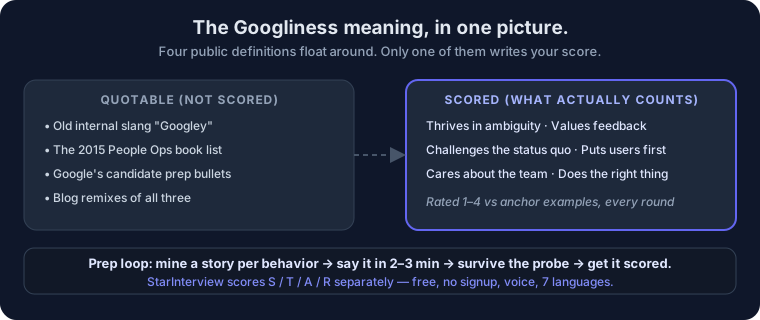
So when someone asks "what does googliness mean?", the only answer worth studying is: six behaviors, rated 1–4, in every round. If you want the question stems that force those behaviors into the open, the ten real loop questions with STAR-L answers cover each attribute.
The Four Googliness Questions and the Six Scored Behaviors — the Complete Crosswalk
Googliness in Google's own words is four questions — how you work on a team, how you help others, how you navigate ambiguity, how you push outside your comfort zone — and those four map cleanly onto the six behaviors the rating form scores. Prep the crosswalk, not the quotes.
Most prep articles present one list or the other: the four framing questions from Google's candidate materials, or the six interviewer rubric behaviors. Nobody joins them — so candidates memorize a list without knowing which question will trigger which behavior, or vice versa. Here is the join, written out. Each cell is the evidence type a scored 3–4 answer has to contain (all examples self-authored; we paraphrase no one's quotes):
| Google's framing question | Rubric behaviors it triggers | Evidence a scored answer needs |
|---|---|---|
| How you work — individually and on a team | Cares about the team · Challenges the status quo | A named moment credit flowed outward (what the team gained) and a decision you contested with data — not a "we synergy" anecdote |
| How you help others | Does the right thing · Values feedback | Unasked-for help with a measurable downstream effect, plus one time you took a correction that stung and changed practice because of it |
| How you navigate ambiguity | Thrives in ambiguity · Puts the user first | How you created the spec yourself (who you asked, what proxy metric you chose) and how you kept the user — not the void — as the tiebreaker |
| How you push outside your comfort zone | Thrives in ambiguity · Challenges the status quo (self-directed) | A skill or role you took before you were ready, with the cost named — intellectual humility lives in this cell; stories without a cost read as rehearsed |
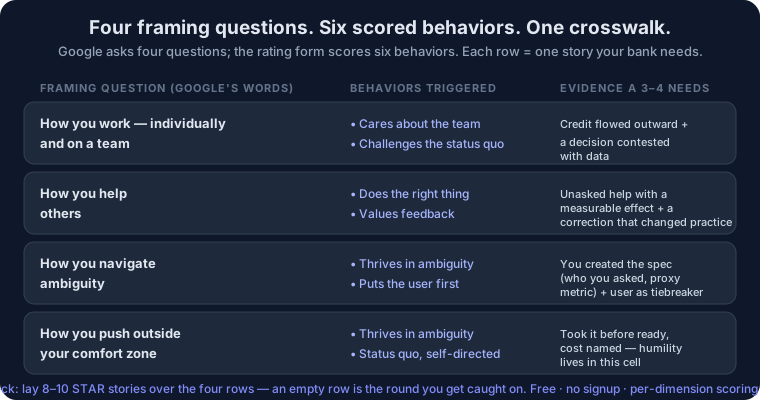
Use it as a coverage check: lay your 8–10 stories over the four rows. A row with no story behind it is the round you will get caught on — and because all six behaviors appear in at least one row, a story bank that covers the four questions cannot leave a scored behavior unevidenced. Want the actual question stems that fire these behaviors? The googliness questions page tags each of its ten loop questions to a row of this table.
What a Googliness Round Actually Sounds Like
Three exchange patterns built from the question stems and follow-ups candidates consistently report from real Google behavioral rounds. The shape matters more than the content — notice where the interviewer pushes, and what the answer is missing when they do.
Exchange 1 — the ambiguity probe
Interviewer: "Tell me about a time you had to act without a clear spec."
Candidate: "My manager asked me to improve our build process but didn\'t define it. I looked at our CI metrics, found a 45-minute pipeline, ran interviews with five teams to find the worst pain, and set a target of 15 minutes before writing any code. We hit 12."
Interviewer: "Who did you have to convince to let you work on that instead of feature work?"
← The follow-up is testing whether you created structure alone or negotiated for it — "influence without authority" is the real question underneath.
Exchange 2 — the humility probe
Interviewer: "Tell me about a time you were wrong."
Candidate: "I pushed hard for a WebSocket architecture for a quarter. A teammate argued for SSE. We benchmarked both — the data showed he was right for our traffic. We shipped SSE and it handled 10x load. But honestly, I lost a week of engineering time because I argued instead of benchmarking first."
Interviewer: "What would you do differently next time?"
← Naming your own cost unprompted is what separates a strong Googleyness score from a rehearsed one. If the candidate had said "nothing — the outcome was fine", the answer fails the probe.
Exchange 3 — the ownership probe
Interviewer: "Describe a difficult teammate."
Candidate: "A teammate kept missing deadlines and it blocked our release train. After two escalations with nothing changing, I went to my manager together with him — not about him — and we restructured who owned the dependency."
Interviewer: "Why involve him in the escalation?"
← The first answer scored a 2 — the evidence was escalation, which reads as "couldn\'t resolve without authority." The rewrite (went together, addressed the system not the person) is the 4. The interviewer is scoring the repair mechanism, not the conflict.
How to Prepare for the Google Googliness Round
- Map your stories to Googliness traits. Prepare 8-10 STAR stories covering intellectual humility, bias to action, comfort with ambiguity, collaboration, and challenging the status quo. Use our STAR answer generator to structure them.
- Practice with a timer. Each answer should be 2-3 minutes. Use our AI practice tool to get real-time feedback on pacing and structure.
- Show intellectual humility. Google explicitly values people who change their minds based on data. Have at least one story where you were wrong and course-corrected.
- Quantify your impact. Even in behavioral rounds, Google interviewers want numbers. "Reduced latency by 40%" is better than "improved performance."
- Prepare for follow-up questions. Google interviewers will probe deeper than most companies. They'll ask "What specifically did you do?" and "What was the measurable outcome?" Have details ready.
Practice Googliness Answers with AI
Get instant AI feedback on your STAR structure, clarity, and impact. Practice Googliness questions for free — no signup required.
Start Practicing Now →Frequently Asked Questions
What does Googliness mean in Google interviews?
Googliness (sometimes spelled "Googleyness") is Google's term for the set of behavioral and cultural attributes they look for in every hire. It encompasses intellectual humility, bias to action, comfort with ambiguity, collaborative nature, valuing diverse perspectives, and a willingness to challenge the status quo constructively. It's not about being "quirky" or "Googley" in a superficial way — it's about demonstrating that you can thrive in Google's specific culture of autonomous, collaborative, data-driven work.
How is Googliness evaluated at Google?
Googliness is evaluated primarily during the behavioral interview round (sometimes called the "Googliness round" or "general cognitive ability" round). The interviewer asks structured behavioral questions and scores your responses against specific rubric criteria: leadership, role-related knowledge, and Googleyness. Your Googliness score is one of four dimensions every interviewer rates. It's not pass/fail — it's a weighted component of your overall hiring packet that goes to the hiring committee.
How do I prepare for the Googleyness round?
Prepare 8-10 STAR method stories that demonstrate: intellectual humility (times you changed your mind based on data), bias to action (times you made decisions with incomplete information), comfort with ambiguity (times you navigated unclear situations), collaboration (times you worked across teams or helped others), and challenging the status quo (times you proposed and drove change). Practice delivering each story in 2-3 minutes using our free AI practice tool at starinterview.org/practice.
Is Googliness the same as cultural fit?
No, and the distinction matters. "Cultural fit" is often used as a vague, subjective assessment that can introduce bias. Google explicitly defines Googliness through specific, measurable behavioral attributes. You're not being judged on whether you'd be "fun to grab a beer with" — you're being evaluated on concrete behaviors like intellectual humility, data-driven decision-making, and collaborative problem-solving. Google moved away from "culture fit" terminology specifically because of its bias risk.
How many Google interview rounds are there?
A standard Google interview process includes: 1-2 phone screens (45-60 minutes each), followed by an onsite loop of 4-5 interviews (45 minutes each). Typically 2-3 rounds are technical (coding, system design, or algorithms), and 1-2 rounds are behavioral/general cognitive ability (the Googliness round). After the onsite, your packet goes to a hiring committee (not the interviewers) who make the hire/no-hire decision. The entire process typically takes 4-8 weeks.
What is the Googliness round in a Google interview?
The Googliness round is the behavioral interview inside Google's onsite loop — often paired with leadership ("Googleyness & Leadership") and run as a 40-45 minute structured behavioral conversation. The interviewer asks STAR-style prompts ("tell me about a time…"), then probes a second layer ("what would you do differently?", "whose numbers were those?"). In some loops, especially for senior or refourced candidates, there is no separate Googliness round: the same behaviors are scored inside every technical round. Either way, the score is the same rubric — which is why story prep should target every round, not one.
What does it mean to be "Googley"?
"Googley" is the older internal slang the whole concept grew out of: employees used it informally for "do the right thing, be curious, don't be evil." Because it meant something different to every employee, it drifted into a bias-prone "culture fit" shortcut — interviewers quietly using it to mean "reminds me of me." Google responded by retiring the vibe and defining the behaviors instead (comfort with ambiguity, valuing feedback, challenging the status quo, putting users first, caring about teammates, doing the right thing). So "being Googley" today effectively means demonstrating those scored behaviors — not matching a personality stereotype.
What are Googliness principles and values — is there something official to read?
Yes, three public things: Google's interview prep materials (which summarize Googleyness as thriving in ambiguity, valuing feedback, effectively challenging the status quo, doing the right thing, and dreaming big), the company philosophy page "Ten Things We Know to Be True" (which Google itself points candidates to for context), and the published hiring-attribute framework used in interviewer training (GCA, Leadership, Role-Related Knowledge, Googleyness). None of them is a checklist you can memorize — they are inputs for story mining. Read them, then write one STAR story per behavior and practice saying each out loud in 2-3 minutes.
What is the "Googliness and Leadership" interview?
It is the same behavioral round under its full name. Google candidate materials and interviewer training pair the two because the round scores both dimensions at once: Googliness (how you collaborate, handle ambiguity, take feedback) and Leadership (influencing without authority, driving outcomes, mentoring). Recruiter emails and prep sites call it "Googliness," "Googleyness & Leadership," "Leadership and Rapport," or fold it into "General Cognitive Ability" — different labels, one rubric. Whatever your loop calls it, expect past-tense STAR prompts and second-layer probes, and prepare stories that demonstrate both dimensions, since one strong story can score both.
What is STAR-L and should I use it for the Googliness round?
STAR-L is the STAR method with a fifth beat: Situation, Task, Action, Result, plus Learnings. For most behavioral interviews the L is optional polish — but at Google it directly feeds the most heavily weighted Googliness attribute, intellectual humility. Closing with "what that changed about how I work now" gives the interviewer explicit evidence that you update your beliefs against evidence, which is exactly what the rubric scores. Use it on every Googliness-round story: one sentence of learning, concrete behavior change, no moralizing. Our practice tool scores S/T/A/R separately so you can check the four scored beats before you add the L.
How should I prepare for the googliness round?
Prepare against the rubric, not the round name. Mine 8-10 STAR stories so every scored behavior has at least one story: a time you were wrong and course-corrected (humility), a project with no spec you defined yourself (ambiguity), a teammate you unblocked (collaboration), a process you changed with data (status quo). Then rehearse out loud at 2-3 minutes per story and stress-test each one against the second-layer probes — "what specifically did you do?", "whose numbers were those?" — because that is where scores separate. A last useful step: have a stranger (or an AI scorer) rate your S/T/A/R structure before the loop, since you cannot hear your own rambling.
Where do I find real googliness round questions and answers?
Two places worth your time. First, our sibling page lists ten questions pulled from reported real Google loops — each one tagged to the attribute it tests, with a complete STAR-L example answer you can reverse-engineer: starinterview.org/interview-questions/googliness. Second, r/cscareerquestions and Google alumni threads carry first-person loop reports, but read them for the question stems and probe patterns, not for "official" answer keys — Google does not publish model answers, and any thread claiming one is guessing. What actually gets scored is the evidence density of your own stories.
What is asked in the googliness round, in Google’s own words?
Google’s candidate prep guidance compresses the round into four framing questions: how you work individually and on a team, how you help others, how you navigate ambiguity, and how you push yourself outside your comfort zone. Every scored rubric behavior maps onto at least one of the four — we keep a full crosswalk of four questions × six behaviors × evidence type in the section above. The practical use: before your loop, tag each of your 8–10 STAR stories with which of the four questions it answers; a story bank that covers all four is a story bank that cannot be surprised by the round name on your itinerary.
Related Interview Guides
Googliness is one piece of the Google interview puzzle. Explore these guides to prepare for every round.
Behavioral Interview Questions
Master behavioral questions across all competency areas with STAR examples.
Software Engineer Interview
Prepare for technical and behavioral rounds at top tech companies.
30 Behavioral Questions & Answers
Detailed STAR answers for the most common behavioral interview questions.
STAR Method Guide
Learn the STAR method framework with examples and practice tips.
Practice with AI
Get instant feedback on your interview answers with our free AI coach.