By Competency
How to Answer 'Tell Me About Yourself' with the STAR Method
The quick answer: Tell me about yourself is a framing question, not a biography request: name your current role and one quantified win relevant to the job, trace two or three steps that got you here, close with why this role is the logical next step. 60-90 seconds, present-past-future — then stop, because follow-ups come from what you chose to say.
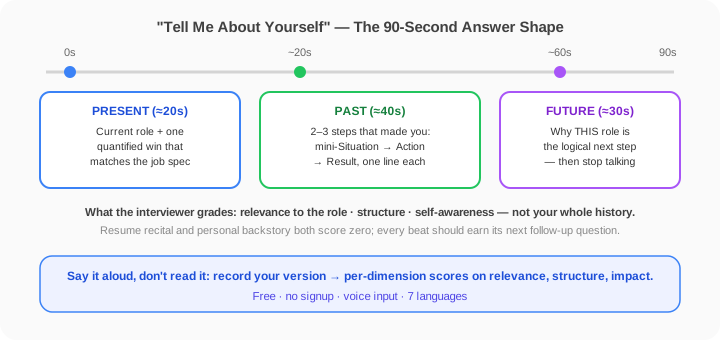
'Tell me about yourself' is the most common interview opening. It's not an invitation to recite your resume — it's a chance to set the narrative for the entire interview.
Why Interviewers Ask These Questions
- 1The interviewer wants a quick snapshot of your professional journey.
- 2They're evaluating your communication skills and self-awareness.
- 3Your answer sets the frame for the rest of the interview.
1 Interview Questions with STAR Answers
Tell me about yourself.
I'm a product manager with 5 years of experience in B2B SaaS, most recently at a Series B startup.
In my current role, I own the entire onboarding experience for new enterprise customers.
I redesigned the onboarding flow based on customer interviews and data analysis, reducing time-to-value from 14 days to 5 days. I also built a self-serve onboarding track that handles 60% of customers without CSM involvement.
These changes improved 90-day retention by 18% and freed up our CSM team to focus on high-value accounts. I'm now looking to bring this user-centric, data-driven approach to a larger-scale product.
💡 Tips for this answer
- •Use the Present-Past-Future framework: where you are, how you got here, where you're going.
- •Keep it to 90 seconds — they'll ask follow-ups if interested.
- •End with why you're excited about THIS role.
Common Mistakes to Avoid
- ✕Reciting your entire resume chronologically.
- ✕Going into personal details (hometown, family, hobbies) unless relevant.
- ✕Taking more than 2 minutes.
- ✕Not connecting your story to the role you're interviewing for.
- ✕Being too modest or too boastful.
Frequently Asked Questions
How do you answer tell me about yourself in an interview?↓
Use present-past-future: current role plus one quantified win relevant to the job, two or three steps that explain how you got here, then why this role is the logical next move. Sixty to ninety seconds, then stop — follow-ups come from what you chose to say.
How long should 'tell me about yourself' be in an interview?↓
60-90 seconds, about 150-220 spoken words. Long enough for a current role, one proof point, and your reason for applying; short enough that you keep control of the frame. Past two minutes reads as an inability to prioritize.
What should I say when asked tell me about yourself with no experience?↓
Lead with direction, not history: what you study or train in, one project, internship, or volunteer episode with a measurable outcome, and why this role fits. A concrete artifact with an adoption number stands in for job titles.
Can you use the STAR method to tell me about yourself?↓
Compressed, yes: your 'past' section is a mini-STAR — one situation, your action, a quantified result. Full four-part STAR belongs in the behavioral follow-ups this answer deliberately invites.
What is the best format for a tell me about yourself answer?↓
Three slots with word budgets: ~40 words present (role plus one metric from the job spec), ~80 words past (two steps, each ending on evidence), ~60 words future (direction plus why this role). Roughly 180 spoken words lands at 90 seconds — the length interviewers expect.
Should I mention my education?↓
Only if it's recent (last 3 years) or directly relevant to the role. For experienced professionals, focus on your career trajectory and impact.
Is it okay to end 'tell me about yourself' with a question?↓
Ending on why you want this specific role is stronger than tossing a question back. If you do add one, keep it short and role-related — the goal is a clean handoff into the interviewer's next question, not a debate.
Practice these questions with AI
Get instant feedback on your STAR method answers. Free, no signup.
Start Practicing →